Applied Echocardiography
Improve your cardiac ultrasound technique and learn to interpret common findings.
View part 1


.svg)

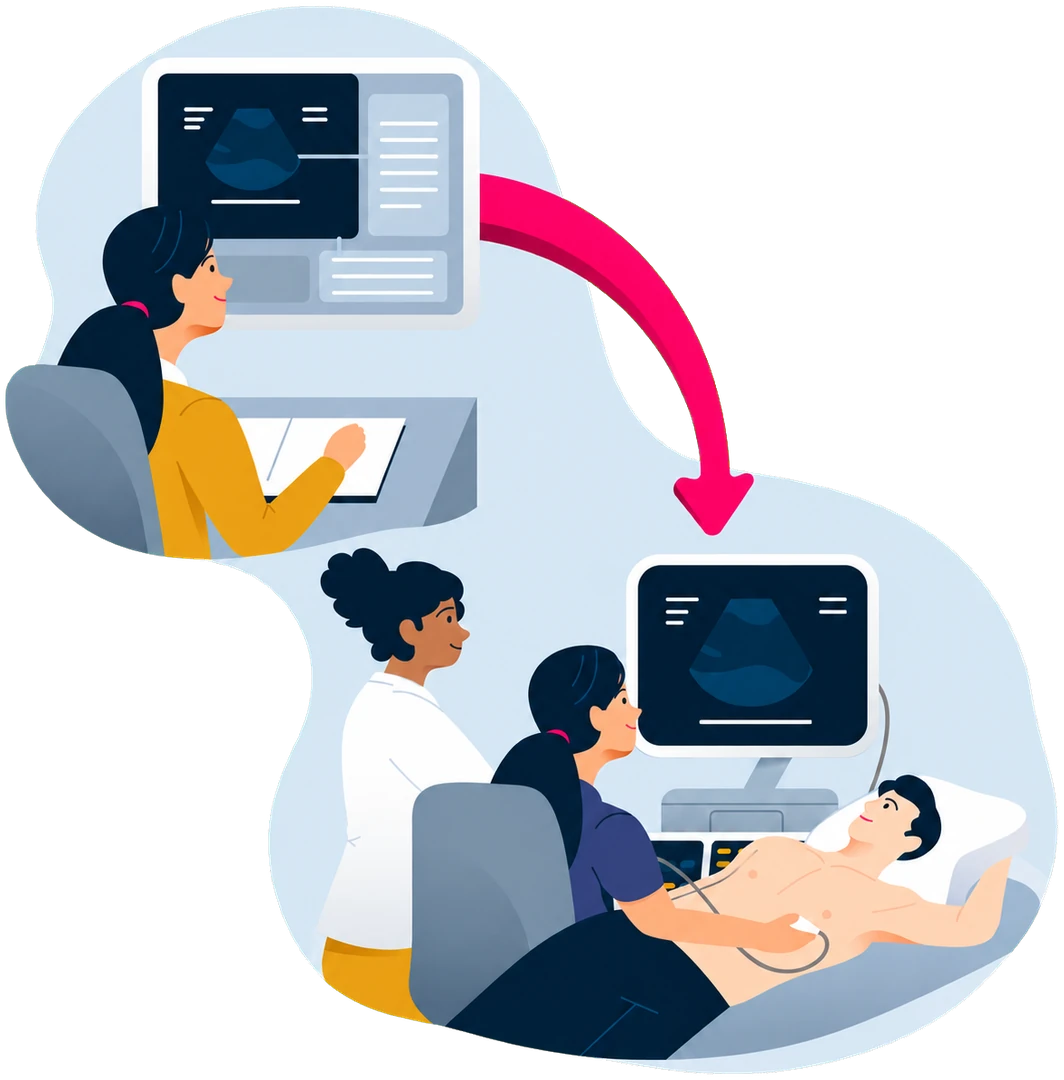
You train hands-on with the same ultrasound equipment used in Heartscope's cardiology clinics.
If you have a science or health degree and want to move into cardiac sonography, this course is a place to start. Over six weeks, our Chief Cardiac Sonographer will introduce you to cardiac ultrasound, also known as echocardiography. You don’t need previous ultrasound experience.
Qualified sonographers are in demand across Australia. In cardiac sonography, you work directly with patients and alongside cardiologists, providing the images and measurements used to assess the heart.
Through our clinical partner Heartscope, successful participants can progress into our three-part career pathway. The pathway combines further learning, clinical observation and paid, supervised training for selected applicants alongside their postgraduate study. Paid positions are limited and subject to interview, selection and university approval.
You'll complete 17 sessions and 68 hours of supervised practical training, alongside online study.

Practise cardiac scanning on clinical ultrasound equipment, with supervision at our Melbourne training centre.

Our Chief Cardiac Sonographer teaches every cohort and provides individual feedback on your scanning technique.

You'll have access to the Scope Institute learning portal for online lessons and course materials.
.svg)

You must have completed an undergraduate degree in science or a related health field before enrolment.
You should be comfortable using a computer to access online lessons and course materials.

You'll need to attend all 17 half-day practical sessions at our Melbourne training centre. These sessions can't be completed online.
You must be able to bring a suitable adult volunteer who agrees to be scanned for training at every practical session.

No previous echocardiography or ultrasound experience is required.
You'll learn each part of a standard echocardiogram, then bring it together through guided practice.
Cardiac anatomy and physiology, the imaging modes, and the standard windows.
Cardiac anatomy and physiology, the imaging modes, and the standard windows.
Cardiac anatomy and physiology, the imaging modes, and the standard windows.
Cardiac anatomy and physiology, the imaging modes, and the standard windows.
Cardiac anatomy and physiology, the imaging modes, and the standard windows.
Cardiac anatomy and physiology, the imaging modes, and the standard windows.
Use system controls including depth, gain, focus, sector width, frequency and presets to improve technically usable images during course exercises.
Practise parasternal long and short axis, apical four, five, two and three chamber, subcostal and suprasternal views under supervision.

Select the appropriate modality, align it correctly, and perform the measurements that depend on it.

Recognise cardiac anatomy and physiology as they appear in each imaging window, and identify structures omitted from a study
Apply patient positioning and breathing techniques, including approaches for technically difficult subjects.

Understand the principles of haemodynamics, chamber quantification and Doppler assessment and how they are applied in a structured basic echocardiography study.
On successful completion, you'll be able to perform a standard echocardiogram on a normal adult in under an hour, with supervision.
You'll develop a consistent routine for scanning and checking image quality.
After successful completion, you can apply for Part 1: Applied Echocardiography.
You'll receive a Scope Institute certificate recording the training you've completed.

Chief Cardiac Sonographer and Educator. Reena holds a Diploma of Medical Ultrasonography (Cardiac) from ASUM and a Certificate IV in Training and Assessment (TAE40122). She co-founded Heartscope and has over 15 years of experience across several public and private cardiology practices.
Reena has trained more than 50 cardiac sonography students. She teaches every Scope Institute echocardiography cohort in small groups, giving individual feedback and following each student's progress.
More about Reena


If you continue to Part 1: Applied Echocardiography after you complete Basic Echocardiography, we'll credit $1,800 of this fee towards Part 1. The credit lasts for 1 year after you complete Basic Echocardiography.
Questions about fees, dates or group places? Contact us
This professional training course provides a Scope Institute certificate, not an ASAR-accredited qualification or Statement of Attainment. It doesn't qualify you as a cardiac sonographer: that takes a separate accredited qualification and its clinical training requirements.
Improve your cardiac ultrasound technique and learn to interpret common findings.
Ask about the pathway, what each stage involves and how to apply.