


To become a cardiac sonographer in Australia, you complete a cardiac sonography course accredited by the Australian Sonographer Accreditation Registry (ASAR), then register with ASAR as an accredited sonographer. The course is usually a part-time graduate diploma or master's taken after a health or science degree, and you study it while working in a supervised clinical training position. Finding that position is often the hardest step.
Scope Institute's echocardiography pathway is hands-on, in-depth training for the practical side of that route. You take it before and alongside your university course, and it prepares you for the day-to-day work of a cardiac sonographer.
What does a cardiac sonographer do?
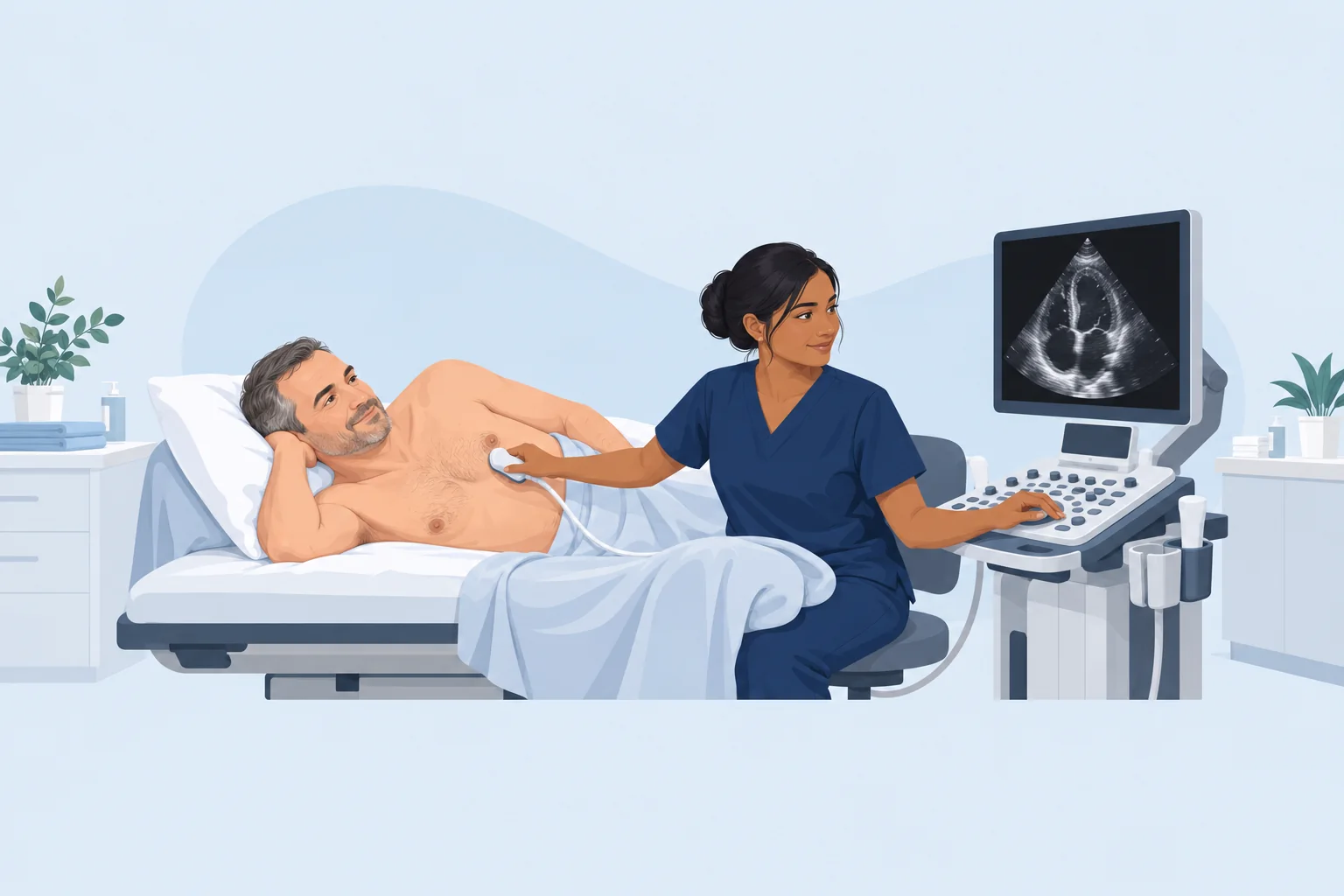
A cardiac sonographer, also called an echocardiographer, performs echocardiograms, which are ultrasound scans of the heart. They produce the images and measurements a cardiologist uses to assess how the heart is working.
In a standard scan, the sonographer holds a probe on the patient's chest and works through a set of views, such as the parasternal long-axis and apical four-chamber views. With 2D imaging, M-mode and Doppler, they measure the heart's chambers, assess how well it pumps and check blood flow through the valves. They also judge whether the images are good enough for diagnosis and draft a preliminary report for the cardiologist to review.
Depending on the workplace, the role can include stress echocardiograms, where the heart is scanned before and after exercise. It's patient-facing work, so explaining the test and keeping people comfortable on the bed are part of the job. Cardiac sonographers work in public and private hospitals and in cardiology clinics.
What are the steps to become a cardiac sonographer in Australia?
For most people, it's a postgraduate route with six steps.
- Finish a relevant bachelor's degree. Health and science degrees are the usual starting point, and some universities want human anatomy and physiology subjects.
- Secure a supervised clinical training position in cardiac ultrasound, usually for at least three days a week.
- Enrol in an ASAR-accredited cardiac sonography course.
- Register with ASAR as a student sonographer once you have your clinical placement.
- Complete the course and its clinical training. The Australasian Sonographers Association (ASA) recommends at least three days a week over two years, about 2,200 hours.
- Upgrade to Accredited Medical Sonographer when you graduate.
Do you need ASAR accreditation to work as a cardiac sonographer?
In practice, yes. Sonographers who perform Medicare-rebated ultrasound on behalf of a medical practitioner must be on the Register of Accredited Sonographers, which ASAR maintains on Medicare's behalf.
To be listed as an Accredited Medical Sonographer, you need an ASAR-accredited qualification in medical ultrasound. After that, you stay on the register by meeting ASAR's continuing professional development (CPD) requirements and paying an annual fee.
Students have their own category. ASAR registers people studying an accredited course as Accredited Student Sonographers and says you don't need to join until you have a clinical placement. A conditional category covers people whose employer confirms in writing that they'll enrol in an accredited course within a year.
Which university courses are ASAR-accredited for cardiac sonography?
Only a handful of courses on ASAR's accredited list are cardiac-specific. As of September 2026, the cardiac options include:
- QUT Graduate Diploma in Cardiac Ultrasound: studied online over two years part time, with two-day on-campus blocks in semesters 1 and 3 and a final clinical exam at QUT.
- Adelaide University Graduate Diploma or Master of Medical Sonography (Cardiac): part time and online, with the graduate diploma taking two years. You log at least 2,000 supervised cardiac scans. ASAR's list shows these under the University of South Australia, which became part of Adelaide University in 2026.
- Western Sydney University Graduate Diploma in Cardiac Sonography: two years part time, mixing online and on-campus learning at Campbelltown with at least 21 hours a week of workplace training.
- CQUniversity Bachelor of Echocardiography and Cardiac Physiology/Graduate Diploma of Echocardiography: a four-year, full-time on-campus program in Brisbane and Sydney that school leavers can apply for. The ASA notes that undergraduate-entry programs like this help students with placements.
If you live in Victoria, the online courses let you study from home while you train at a clinical site near you, though QUT still expects you on campus for its blocks and final exam. Course offerings change, so check ASAR's current list before you apply.
What are the entry requirements for cardiac sonography courses?
Expect two main requirements: a completed bachelor's degree in a relevant field, and written proof of a supervised training position in cardiac ultrasound. The details vary by university.
- Western Sydney University asks for a degree in natural and physical sciences or health that includes at least two human anatomy and physiology subjects. You must also secure at least three days a week of work (training) in cardiac sonography and verify it in writing two weeks before the course starts.
- Adelaide University accepts bachelor's degrees in listed fields such as nursing, radiography, health science and human movement, and considers others case by case. You need a letter of support confirming a training position supervised by an ASAR-registered cardiac sonographer.
- QUT asks for a degree in a relevant science or allied health field, such as medical imaging science, biomedical science or nursing. You also need at least three months' full-time-equivalent supervised hands-on experience in cardiac ultrasound, confirmed on a clinical supervisor form.
QUT's rule means you'd already be scanning in a clinical setting before you enrol, so read each course's requirements early.
Why is finding a clinical training position so hard?
Most postgraduate courses expect you to arrange the position yourself before you start, and there aren't many to go around. The ASA says getting a placement can be competitive, and ASAR's FAQ acknowledges that finding one is difficult and that ASAR has no role in arranging placements.
The position is often a trainee job in a hospital or cardiology practice, where an accredited cardiac sonographer supervises your scanning. QUT, for example, aims its course at student cardiac sonographers employed in a suitable clinical practice.
You also have to keep the position for the whole course. Adelaide University says students who can't maintain their training position may exit with a graduate certificate, which doesn't give ASAR accreditation.
According to the ASA, students find positions through their existing workplaces, job boards such as Seek, CareerOne and the ASA Jobs Board, or by contacting hospitals and private practices directly. ASAR suggests approaching the HR teams of as many imaging practices as you can, locally or further afield.
Where does Scope Institute's echocardiography pathway fit?
Scope Institute's cardiac sonographer career pathway is practical from the first week. In Basic Echocardiography alone, you spend 68 hours in supervised practical sessions, and the later stages take you into Heartscope, the group of cardiology clinics run by our parent company, Scope Healthcare Limited. Most postgraduate courses teach the theory and rely on your clinical training position for most of the scanning. Students sometimes come to us knowing the theory well but unable to apply it with a probe in their hand, and the pathway is where they get that practice.
Each course leads to a Scope Institute certificate. It isn't an accredited qualification, and you'll still need the university course, but it's well regarded because it shows the supervised practice you've done.
- Basic Echocardiography: the entry program, for graduates of a science or related health degree. No echo experience is needed. Over six weeks you complete 17 half-day practical sessions (68 hours) at our Melbourne training centre and at least 24 hours of online learning, bringing an adult volunteer to scan at each session. By the end, you should be able to perform a standard echocardiogram on a normal adult in under an hour, with supervision.
- Applied Echocardiography (Part 1): seven weeks and 108 hours on common conditions such as cardiomyopathies, valve and pericardial disease, and aortic and adult congenital conditions. You also learn to write a preliminary report for review. Entry needs Basic Echocardiography or equivalent training we approve. The course includes one lesson at a Heartscope clinic with supervised probe time, and a progression review decides whether you continue.
- Clinical Rotations (Part 2): eight weeks full time (240 hours) at Heartscope and approved clinical sites, observing echocardiograms and learning how ECG, Holter and blood pressure monitoring fit alongside them. It's unpaid observation, not a scanning placement. Your university decides what, if anything, it recognises from your logbook.
- Industry Based Learning (Part 3): a salaried, supervised trainee position with Heartscope for selected applicants, held full time for 72 weeks alongside postgraduate study. It isn't a Scope course and there's no Scope fee, but you enrol in and pay for your university course separately. The 72 weeks may not cover your whole university course and its clinical requirements.
What is the conditional Heartscope training-position offer?
It's the link between Industry Based Learning and your university application. If you're selected, you receive a conditional Heartscope training-position offer and a clinical training support letter for your university application. The training arrangement still needs your university's approval.
Universities ask for this kind of evidence, such as Adelaide University's letter of support or Western Sydney University's written verification. Each university still decides whether the site, supervision and your prior experience meet its requirements, and whether it needs other documents.
The position is a paid job in a working clinic, where you scan patients under a senior sonographer's supervision. That's why places are limited and filled by interview and Heartscope selection after you complete Parts 1 and 2, and why completing them doesn't guarantee a place. You also need to meet your university's enrolment requirements and hold the ASAR student status your clinical training needs. If you aren't offered a place, you can use your certificates and scanning experience when you apply for training positions elsewhere.
Where should you start?
If you have a science or health degree and haven't scanned before, start with Basic Echocardiography. Before you enrol, read the entry requirements for the university courses you're aiming for, so you know what training position and experience they'll expect. To ask about intakes or how Part 3 selection works, register your interest or book a consultation.
Sources
- ASAR Accredited Courses – Australian Sonographer Accreditation Registry
- Frequently Asked Questions – Australian Sonographer Accreditation Registry
- Information for Prospective Students – Australasian Sonographers Association
- Graduate Diploma in Cardiac Ultrasound – Queensland University of Technology
- Graduate Diploma in Medical Sonography (Cardiac) – Adelaide University
- 4743 Graduate Diploma in Cardiac Sonography (2026 Handbook) – Western Sydney University

.svg)


