


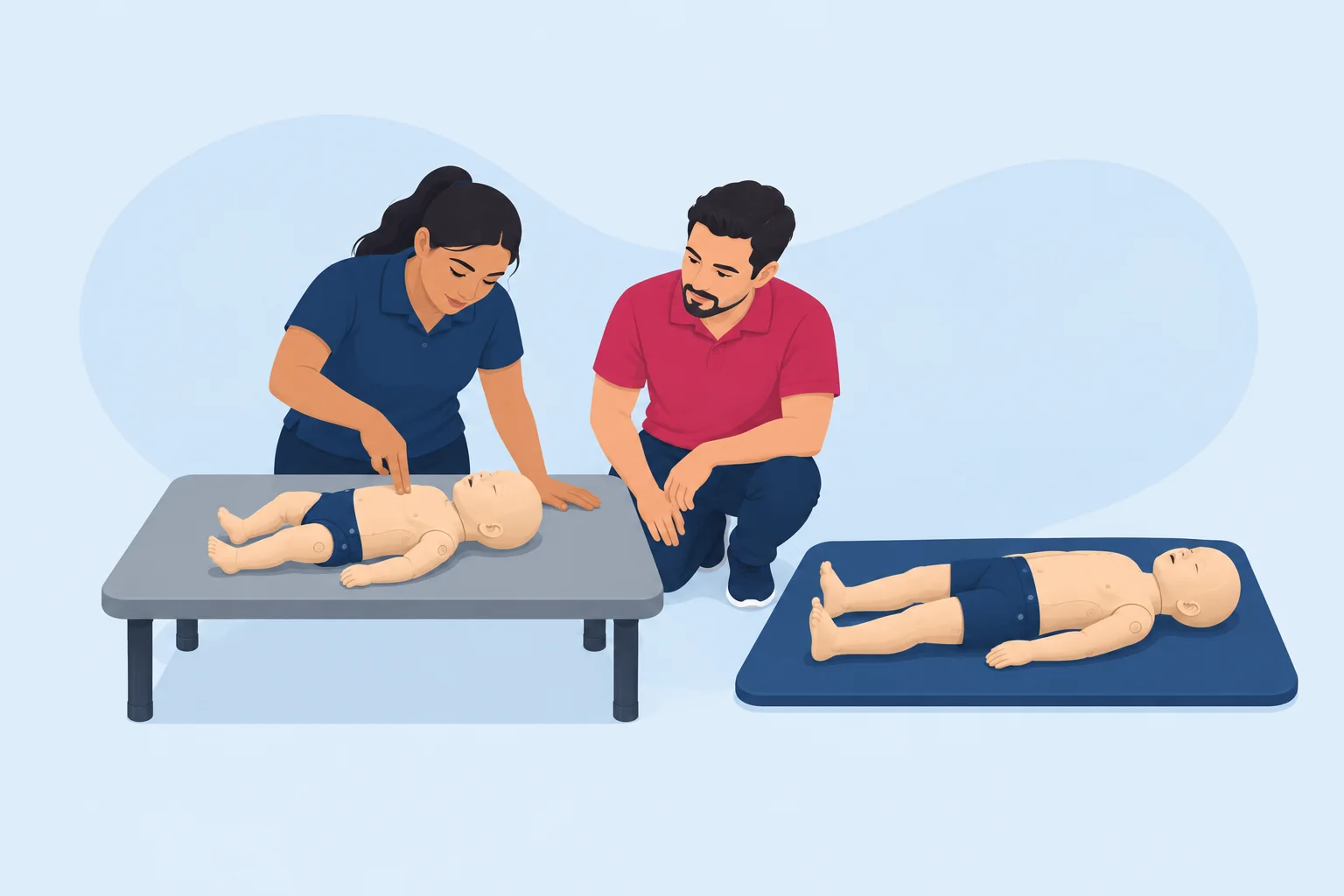
Infant and child CPR follows the same DRSABCD steps as adult CPR, including 30 compressions to 2 breaths at 100 to 120 compressions a minute. The technique changes: two fingers on a baby's chest and one or two hands on a child's, about 4 cm deep for a baby and 5 cm for a child, a neutral head position for babies, gentler breaths, and child AED pads for under-8s if available.
The clinical details below come from the current ANZCOR (Australian and New Zealand Committee on Resuscitation) guidelines, which nationally recognised CPR training in Australia follows.
What counts as an infant or a child in CPR?
ANZCOR defines an infant as a baby under one year old, and a child as anyone from their first birthday up to 18. If you don't know their age, use the onset of puberty as the line between child and adult (ANZCOR Guideline 4). AED pads use a different cut-off, 8 years, covered below.
In an emergency, go by what you see. ANZCOR's advice is to use child technique if the patient looks like a child and adult technique if they look like an adult. If someone you treated as a child turns out to be a young adult, it's unlikely any harm has been done.
When should you call Triple Zero (000)?
Call Triple Zero (000) as soon as you find a baby or child who doesn't respond. That's the S, for send for help, in the DRSABCD action plan.
Get anyone else with you to make the call and bring an AED while you start CPR. Ambulance Victoria says the call-taker will talk you through CPR and using an AED, so stay on the line until they tell you to hang up.
Should you tilt a baby's head back?
Not the way you would for an older child or adult. Keep a baby's head in a neutral position, with the head and neck in line rather than tipped back, and support the jaw at the point of the chin (ANZCOR Guideline 4).
A baby's windpipe is narrow and soft, and tilting the head too far back can bend it out of shape and block the airway. Keep your fingers off the soft tissue of the neck. Tilt the head back only if the neutral position doesn't give a clear airway, and then very slightly and gently.
For a child, use head tilt and chin lift, as you would for an adult.
What hand position do you use for infant and child CPR?
At every age, you press on the lower half of the breastbone, in the centre of the chest. What you press with depends on the patient's age and size (ANZCOR Guideline 6):
- Infant: two fingers. ANZCOR suggests this for lay rescuers because it lets you move quickly between compressions and breaths.
- Child: the heel of one hand, or two hands as for an adult, whichever lets you reach the right depth.
- Adult, for comparison: the heel of one hand with the other hand on top.
Lay the baby or child on their back on a firm surface before you start, as it makes compressions more effective.
You may have seen the two-thumb technique, where both hands wrap around a baby's chest and the thumbs press on the breastbone. That's ANZCOR's method for health professionals trained in paediatric life support (Guideline 12.1, updated April 2026), while first aiders use two fingers.
How deep and how fast should you push?
Push down about one third of the depth of the chest. ANZCOR Guideline 6 puts that at about 4 cm for an infant and 5 cm for a child, compared with more than 5 cm for an adult.
The rate doesn't change with age: 100 to 120 compressions a minute, which is almost two a second. Let the chest come all the way back up after each compression.
Don't hold back because the chest is small. ANZCOR's view is that the risk of compressions being too shallow outweighs the risk of them being too deep.
Is child CPR still 30 compressions to 2 breaths?
Yes, for first aiders. ANZCOR Guideline 8 recommends 30 compressions to 2 breaths for all ages. Health professionals trained in paediatric life support use 15:2 instead (Guideline 12.1), so you may hear both.
Children's cardiac arrests usually follow a breathing problem rather than starting in the heart, so ANZCOR puts extra weight on rescue breaths for them. To give breaths (ANZCOR Guideline 5):
- For a baby, cover their mouth and nose with your mouth.
- For a child, pinch the nose closed and seal your mouth over theirs.
- Blow for about one second, with just enough air to make the chest rise. For a baby, that's a small, gentle breath. Don't over-inflate the chest.
- If the chest doesn't rise, check the head position and your seal before the next breath.
If you can't give breaths, keep doing compressions. ANZCOR asks every rescuer to do at least that.
Can you use an AED on a child or baby?
Yes, including babies under one. ANZCOR Guideline 7 says standard adult AED pads are suitable for children older than 8. For younger children and babies, the ideal is paediatric pads and an AED with a paediatric mode. If the AED has neither, go ahead with the adult pads.
When you place the pads:
- Follow the diagram on the pads. The standard position on the bare chest, for children as for adults, is one pad below the right collarbone and one on the left side, below the armpit.
- Make sure the pads don't touch each other.
- On a small chest where they'd touch, put one on the upper back between the shoulder blades and the other on the front of the chest, slightly to the left if possible.
Keep doing CPR until the AED is on and the pads are attached, then follow its prompts and make sure no one touches the child during a shock. Our guide to what an AED's pads, prompts and shock button do explains the device itself.
Where can you practise infant CPR?
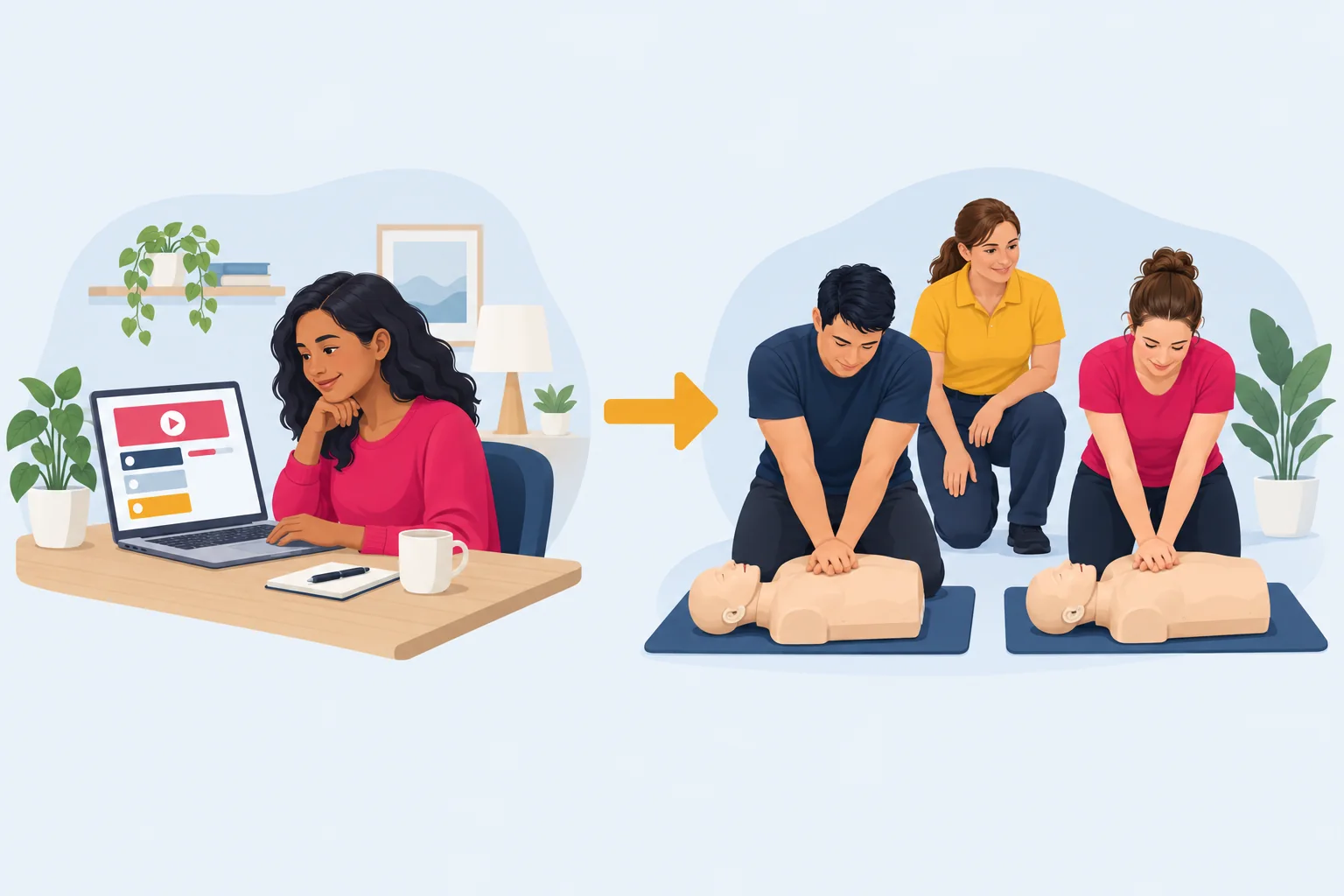
This article is general information, not a substitute for hands-on training. Both our nationally recognised courses include infant CPR. The HLTAID009 assessment requirements, like HLTAID011's, include at least 2 minutes of uninterrupted CPR on an infant manikin on a firm surface.
If you work in early childhood education and care, check your regulator's first aid requirements before you enrol, as those roles may need a different unit.
The HLTAID009 Provide CPR course covers CPR on its own. HLTAID011 Provide First Aid is the full first aid certificate, with the same CPR skills plus injury and illness management. For a team, we can run either course at your workplace in metropolitan Melbourne: ask about on-site group training.
Sources
- Guideline 4 – Airway – ANZCOR
- Guideline 5 – Breathing – ANZCOR
- Guideline 6 – Compressions – ANZCOR
- Guideline 7 – Automated External Defibrillation in Basic Life Support – ANZCOR
- Guideline 8 – Cardiopulmonary Resuscitation (CPR) – ANZCOR
- Guideline 12.1 – Paediatric Basic Life Support (PBLS) for health professionals – ANZCOR

.svg)


