



At your first aid practical assessment, your trainer watches you perform each skill the unit requires, on manikins and in simulated emergencies. For both HLTAID011 and HLTAID009, that includes at least 2 minutes of uninterrupted CPR on an adult manikin on the floor, CPR on an infant manikin and use of a training AED. There's no mark, and your result is competent or not yet competent.
For what to bring and wear, see how to prepare for your first aid practical session.
What does the assessor check in a first aid practical assessment?
Your trainer, who's also your assessor, judges what you do against each unit's assessment requirements on training.gov.au. Before assessing, they'll check your photo ID, explain what they need to see and coach each skill.
Both units list the same CPR tasks. You need to:
- position an unconscious casualty who's breathing so their airway is protected
- perform "at least 2 minutes of uninterrupted single rescuer" CPR (5 cycles of compressions and breaths) on an adult manikin placed on the floor
- follow a training AED's prompts to deliver at least one shock
- swap rescuers with minimal interruption to compressions
- respond appropriately if the casualty regurgitates or vomits
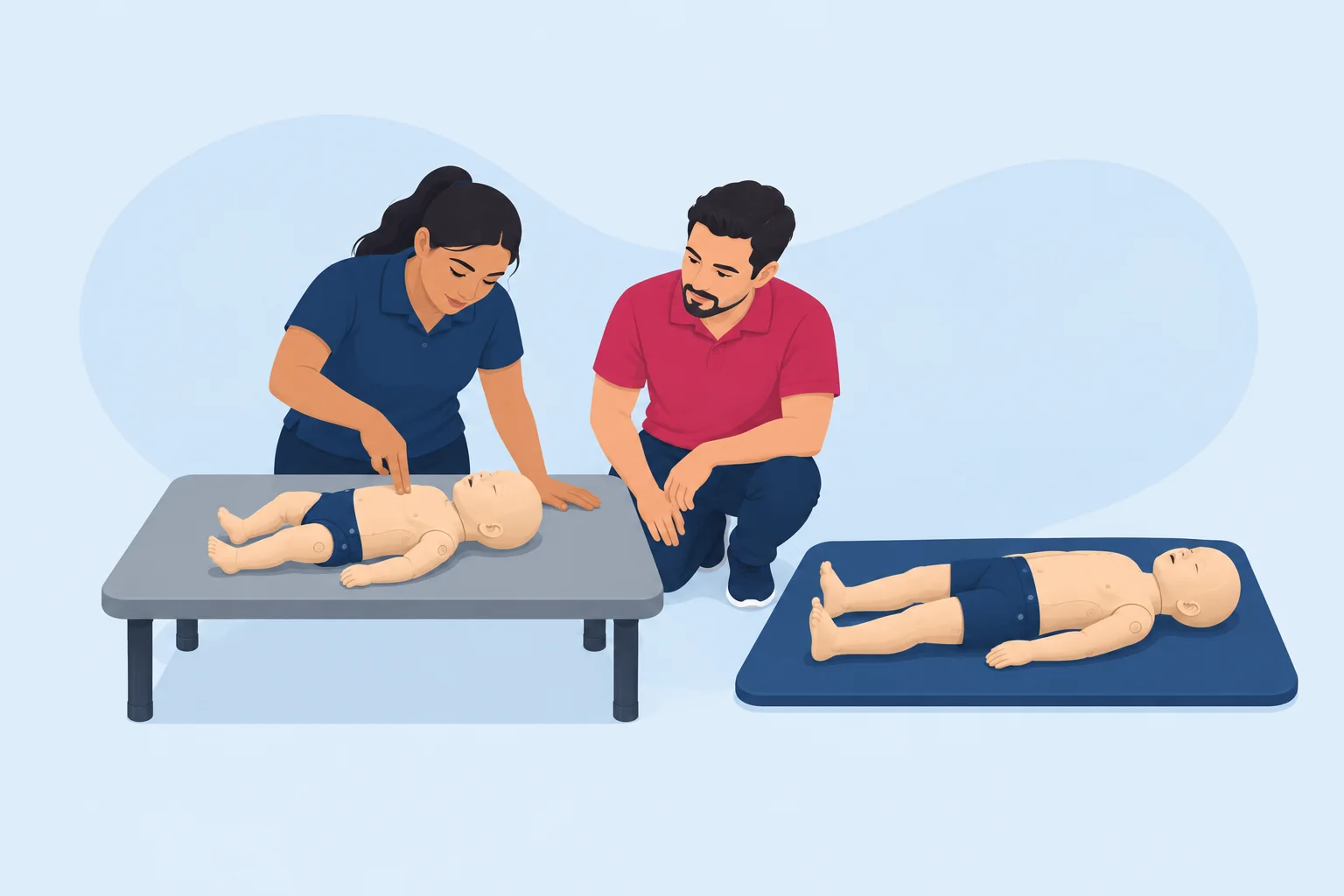
- do the same 2 minutes of uninterrupted CPR on an infant manikin placed on a firm surface
CPR must follow Australian Resuscitation Council guidelines, published by ANZCOR. For an adult, that means 30 compressions to 2 breaths at 100 to 120 a minute, pressing about a third of the chest's depth. If the casualty vomits, roll them onto their side and clear the airway before continuing. The steps before CPR count as well, including calling Triple Zero (000).
HLTAID009 adds a handover to emergency services, an accurate verbal report and a review of the incident. On our HLTAID009 Provide CPR course, these happen in a simulated cardiac arrest scenario.
How do first aid assessment scenarios work?
Scenarios are simulated emergencies that you handle as you would a real one. The units require them to be realistic, with proper equipment.
In HLTAID011 Provide First Aid, you also manage casualties with:
- anaphylaxis and asthma
- choking
- non-life-threatening bleeding, minor wounds and a nosebleed
- envenomation, such as a snake bite, using pressure immobilisation
- fractures, dislocations, sprains and strains, using immobilisation
- shock
At least one HLTAID011 scenario is set somewhere like your workplace or community, and you aren't told the casualty's condition beforehand. You'll be expected to:
- work out the illness or injury from their history, signs and symptoms
- use personal protective equipment (PPE) as needed
- give the right first aid
- pass the details to emergency services, or advise the casualty what to do next
- give an accurate verbal and written report, using an incident report form
- review the incident
Even in a group, you'll do your own 2 minutes of CPR, because the assessor has to see each person do each task.
What does "competent" mean in a first aid course?
Competent means your assessor has enough evidence that you can do everything the unit requires, to the standard it sets. Assessment in vocational education and training (VET) is competency-based, so there's no score or grade.
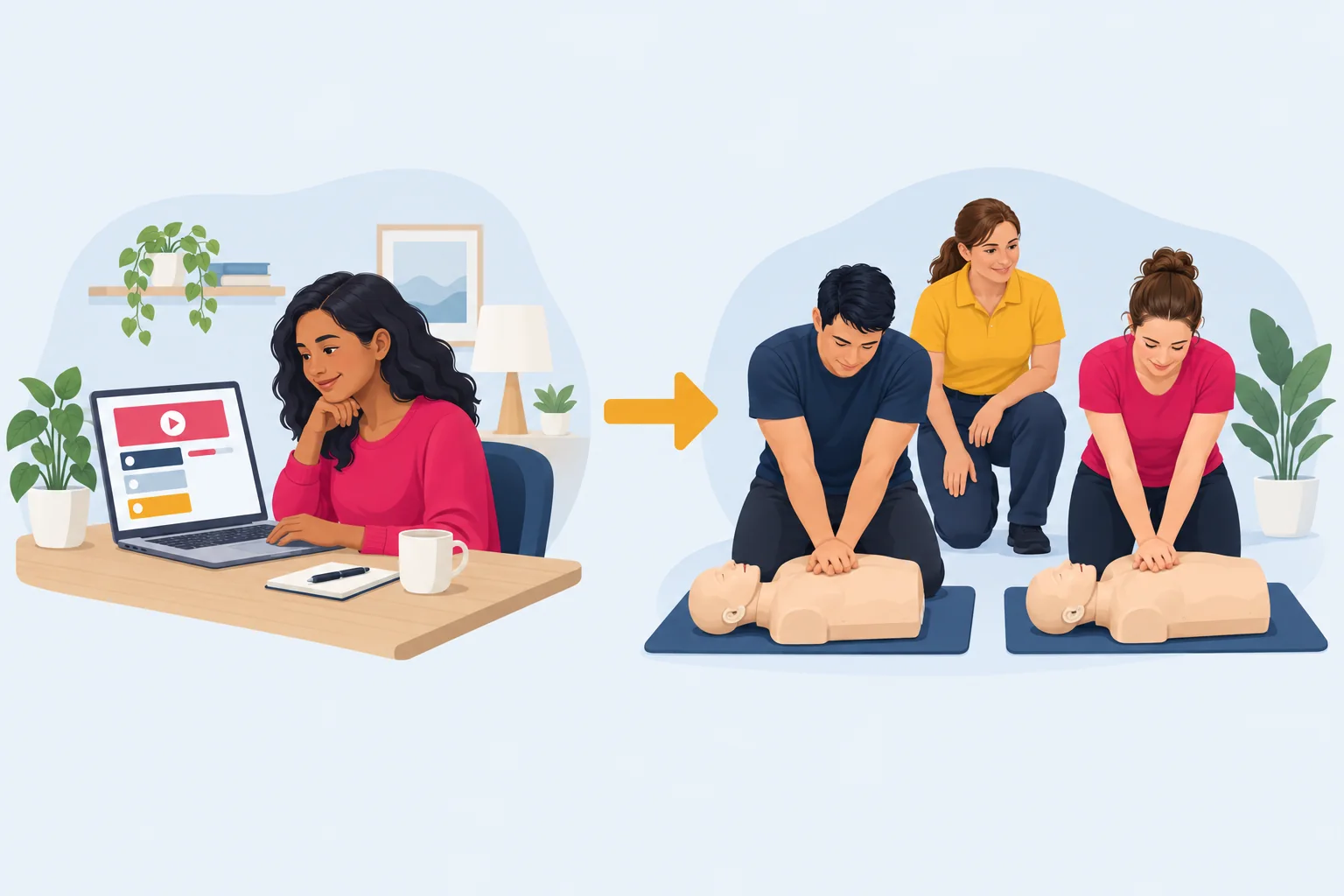
Each task is marked satisfactory or not yet satisfactory, and the unit result is competent or not yet competent. Nothing is averaged: neat bandaging can't make up for CPR that isn't effective yet. The online theory's knowledge questions count too, and you need to finish them before the session.
Under the Standards for RTOs 2025, your evidence must be your own and current, which is why your ID is checked.
Can a first aid assessment be adjusted for injury or disability?
Yes, within limits. A reasonable adjustment changes how you're assessed, but you still have to show everything the unit requires.
Our Student Handbook gives examples such as large print, extra time, assistive technology and one-on-one support. The physical requirements above still apply, though some changes may be possible as long as your CPR is still effective.
Tell us before you book if an injury, disability, pregnancy or health condition could make kneeling or compressions hard. If you can't meet the requirements even with adjustments, you'll get a Statement of Attendance instead of a Statement of Attainment. If we can't make an adjustment you've asked for, we'll explain why in writing, and you can appeal.
What happens if you're not yet competent on the day?
Your trainer tells you what needs to improve and arranges another attempt with you. Under our Fees, Payments and Refunds Policy, your first two further attempts are free, and each one after that costs $25.
If you think the result is wrong, you can appeal within 20 business days of being told it. A different assessor will review it and may reassess you.
When do you get your results and Statement of Attainment?
We usually issue your Statement of Attainment by email within 1 business day of you finishing the online theory and the practical, once your USI is verified and fees are paid. Our terms and the national RTO standards both set 30 calendar days as the outer limit. If an employer booked your place, an unpaid invoice won't delay your certificate, and the employer only gets your results with your written consent.
A Statement of Attainment doesn't expire, but WorkSafe Victoria's compliance code recommends refreshing CPR every year and first aid every three years, and so does Safe Work Australia's model code in other states and territories. Employers and industries often require it. Our post on CPR and first aid refresher timing explains more.
For questions before your session, call us on 1300 508 809 (Monday to Friday, 9am to 5pm).
Sources
- HLTAID011 Provide First Aid: unit details and assessment requirements – training.gov.au
- HLTAID009 Provide cardiopulmonary resuscitation: unit details and assessment requirements – training.gov.au
- Assessment Practice Guide (Standards 1.3 to 1.5) – Australian Skills Quality Authority
- Basic Life Support guidelines 4 (Airway), 6 (Compressions) and 8 (CPR) – ANZCOR
- Compliance code: First aid in the workplace – WorkSafe Victoria
- Model Code of Practice: First aid in the workplace – Safe Work Australia

.svg)


