


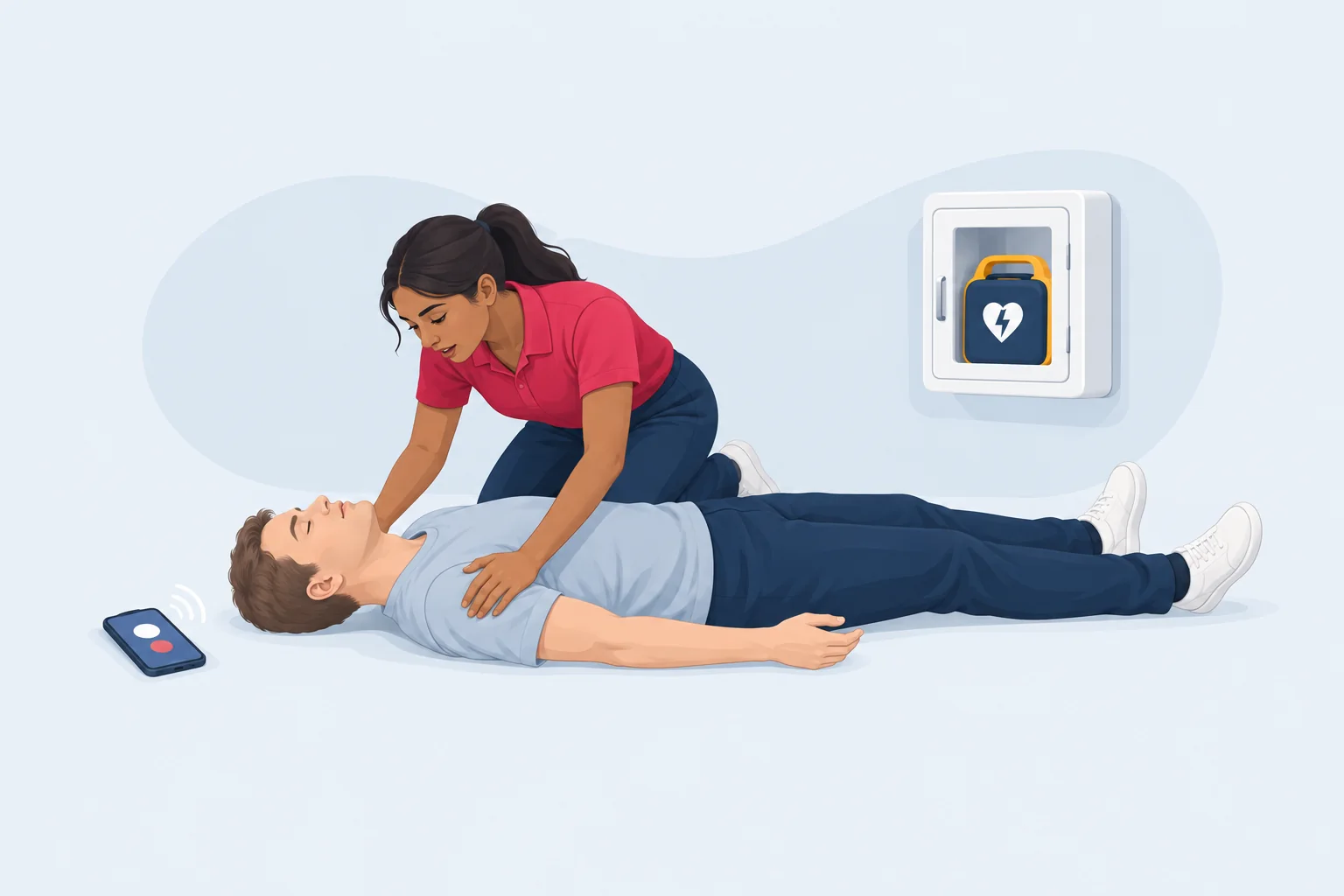
The DRSABCD action plan is what you do when someone collapses: Danger, Response, Send for help, Airway, Breathing, CPR and Defibrillation, in that order. It's the basic life support sequence published by ANZCOR (the Australian and New Zealand Committee on Resuscitation), and you practise it on a manikin in every nationally recognised first aid and CPR course.
What's on the ANZCOR Basic Life Support flowchart?
One step per letter, with three checks that decide your next move.
- Danger: is it safe to approach?
- Response: does the person respond to you?
- Send for help: call Triple Zero (000).
- Airway: open it.
- Breathing: are they breathing normally?
- CPR: 30 compressions, then 2 breaths.
- Defibrillation: attach an AED as soon as one's available.
The flowchart (last reviewed August 2023) ends by telling you to keep doing CPR until the person responds or breathes normally.
Danger: is it safe to help?
Make sure it's safe for you, bystanders and the person before you go closer. ANZCOR's examples include keeping at least 10 metres from a fallen power line until the electrical authority says it's safe, and switching off the power before you touch someone who's had an electric shock at home. If the person is somewhere dangerous, such as a road, you may need to move them.
Response: how do you check if someone is unresponsive?
Talk to them, then touch them. ANZCOR calls this 'talk and touch'. Give a simple command such as 'Open your eyes' or 'Squeeze my hand', then squeeze their shoulders firmly.
Some Australian first aid providers teach the spoken prompts as COWS: Can you hear me? Open your eyes. What's your name? Squeeze my hand. It isn't an ANZCOR term, but it does the same job.
No response, or only a groan without the eyes opening, means you treat them as unresponsive. If they respond, stay with them and keep checking.
Send for help: when should you call Triple Zero (000)?
As soon as you know they're unresponsive. Call Triple Zero (000) and ask for an ambulance, or have someone else call while you stay with them.
If you're alone with a mobile, Ambulance Victoria's advice is to put it on loudspeaker beside the patient so the call-taker can talk you through CPR, and to stay on the line unless they tell you to hang up. If others are around, send one to call and one to fetch the nearest AED.
Airway: how do you open someone's airway?
Check the mouth, then tilt the head back and lift the chin. ANZCOR says to do this in the position you found the person, rather than rolling them over just to check.
- If something's in the mouth, such as vomit, food or blood, roll them onto their side and turn the head slightly downwards so it drains. Clear what you can see with your fingers, but don't sweep blindly.
- If the mouth is clear, leave them as you found them. With one hand on the forehead and the other lifting the chin, tilt the head (not the neck) back.
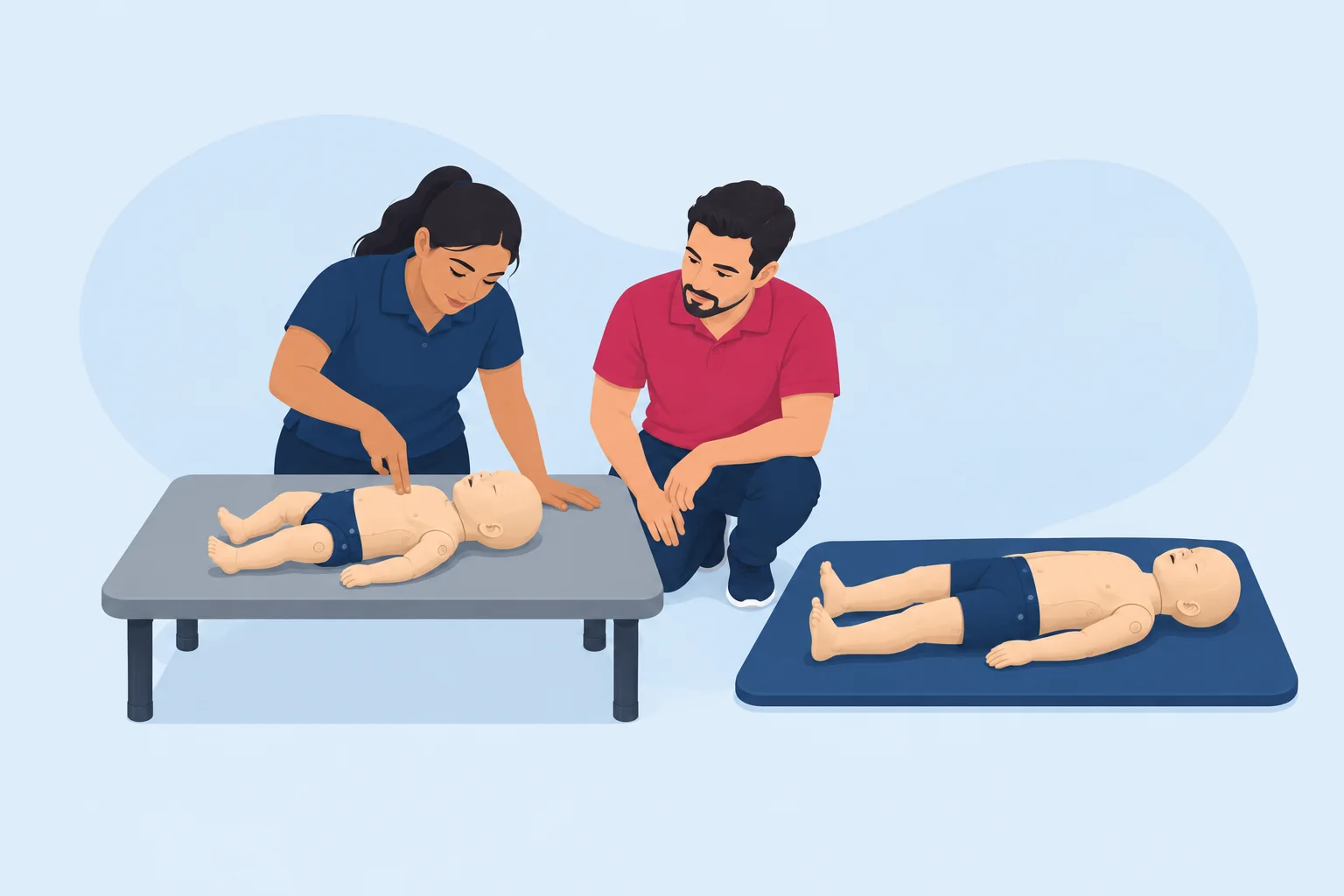
ANZCOR puts an unconscious person's airway ahead of any other injury, including a possible spinal injury. For an infant, keep the head neutral rather than tilted back. Our guide to infant and child CPR covers what else changes.
Breathing: what if it isn't normal?
Start CPR. Anyone who is unresponsive and not breathing normally needs it, and gasping doesn't count as normal. If they're breathing normally, use the recovery position instead.
With the airway open, look, listen and feel. Look for movement of the upper abdomen or lower chest, and listen and feel for air at the nose and mouth. Occasional gasps (agonal gasps) are common after cardiac arrest, and ANZCOR says to start CPR even if they happen.
Don't feel for a pulse. ANZCOR says pulse checks are unreliable and shouldn't decide whether someone gets CPR.
CPR: what are the ratio, rate and depth?
Give 30 chest compressions, then 2 breaths, and repeat. It's 30:2 for all ages, at 100 to 120 compressions a minute (almost 2 a second) and a depth of about one third of the chest.
- With the person on their back on a firm surface, put the heel of one hand in the centre of the chest and the other hand on top.
- Press down about one third of the chest's depth, which is more than 5 cm in an adult, and let the chest come fully back up each time.
- Give each breath over about one second, just enough to make the chest rise.
If you can't or won't give breaths, do compressions only, and don't stop to check for breathing. ANZCOR treats rib fractures as an acceptable consequence of CPR when the alternative is death.
Tiredness shows in your compressions before you feel it. In a manikin study ANZCOR cites, compressions became shallow within a minute, but rescuers only noticed fatigue after five. If someone can take over, swap at least every two minutes.
Defibrillation: when should you use an AED?
As soon as one is available. Keep CPR going until the AED is on and the pads are attached, then follow its prompts.
CPR alone won't save someone in ventricular fibrillation (VF). They need a shock, and ANZCOR's AED guideline puts the drop in survival at about 10% for every minute it's delayed. The machine decides whether to shock, and ANZCOR says AED use shouldn't be restricted to trained people. Keep everyone clear during a shock. Our post on what an AED's pads, prompts and shock button do has the detail.
When do you use the recovery position?
When someone is unresponsive but breathing normally. ANZCOR suggests putting them on their side rather than leaving them on their back, where the tongue can fall back and block the throat and anything they bring up can be inhaled.
Keep the head tilted back so the airway stays open, and don't sit them in a chair or put their head between their knees. Stop any bleeding and keep checking their breathing. If it stops being normal, roll them onto their back and start CPR.
Why is the DRSABCD action plan in every first aid course?
Because the national units assess it. HLTAID009 Provide cardiopulmonary resuscitation and HLTAID011 Provide First Aid both require you to manage an unresponsive person in line with Australian Resuscitation Council guidelines (the ARC is ANZCOR's Australian member). That includes positioning someone who's unconscious and breathing, at least 2 minutes of uninterrupted CPR on an adult manikin on the floor, and following an AED's prompts to deliver a shock.
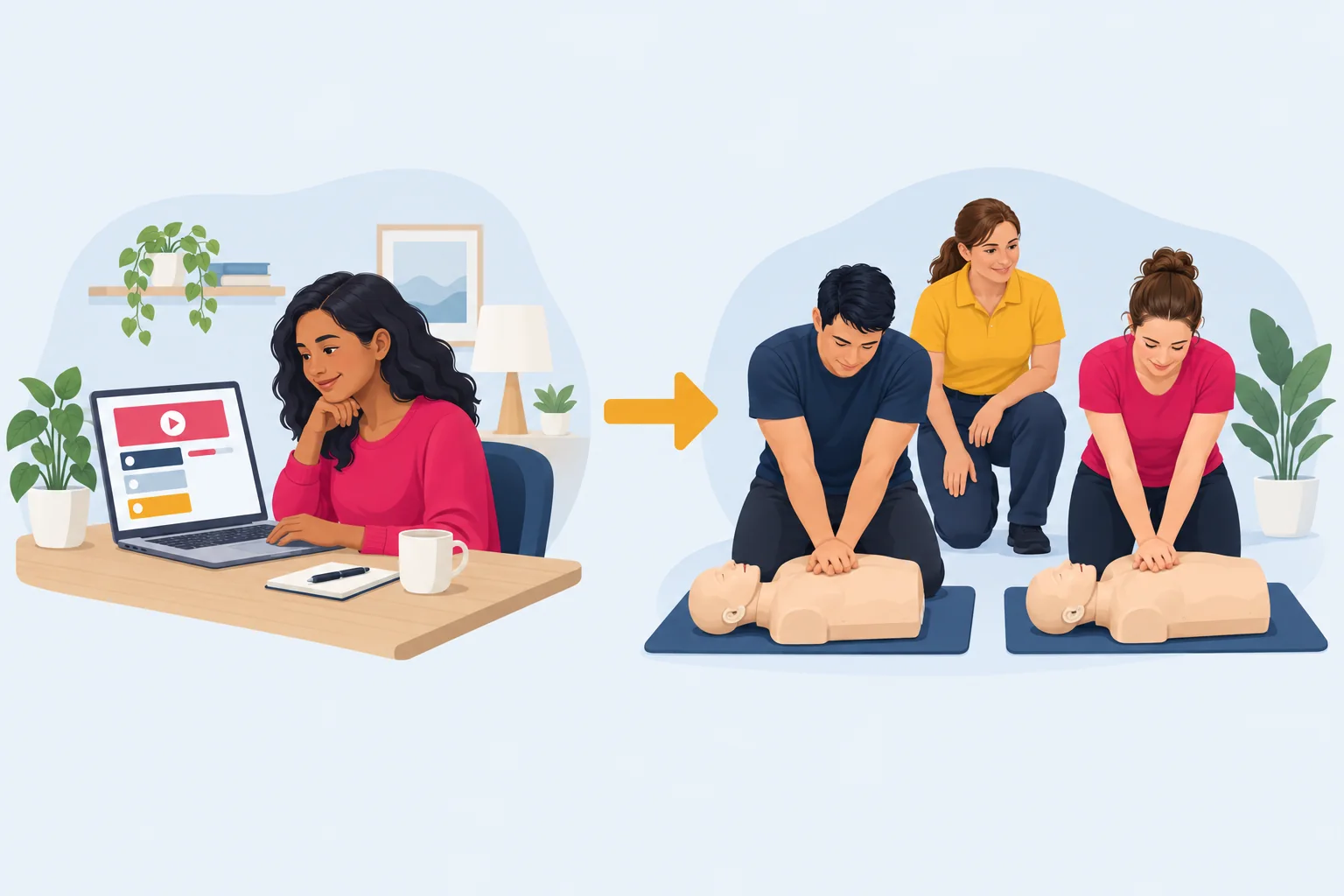
Reading the steps won't make them automatic. ANZCOR's training guideline notes that CPR skills can fade within weeks to months of a one-off course.
For a workplace first aid certificate, our HLTAID011 Provide First Aid course covers DRSABCD plus bleeding, burns, fractures, asthma and anaphylaxis. For CPR alone, the HLTAID009 Provide CPR course covers DRSABCD, adult and infant CPR, and AED use.
Sources
- Basic Life Support Flowchart – ANZCOR
- Basic Life Support guidelines (Guidelines 2 to 8) – ANZCOR
- Guideline 6: Compressions – ANZCOR
- Guideline 7: Automated External Defibrillation in Basic Life Support – ANZCOR
- Call Push Shock: frequently asked questions – Ambulance Victoria
- HLTAID011 Provide First Aid – training.gov.au

.svg)


