


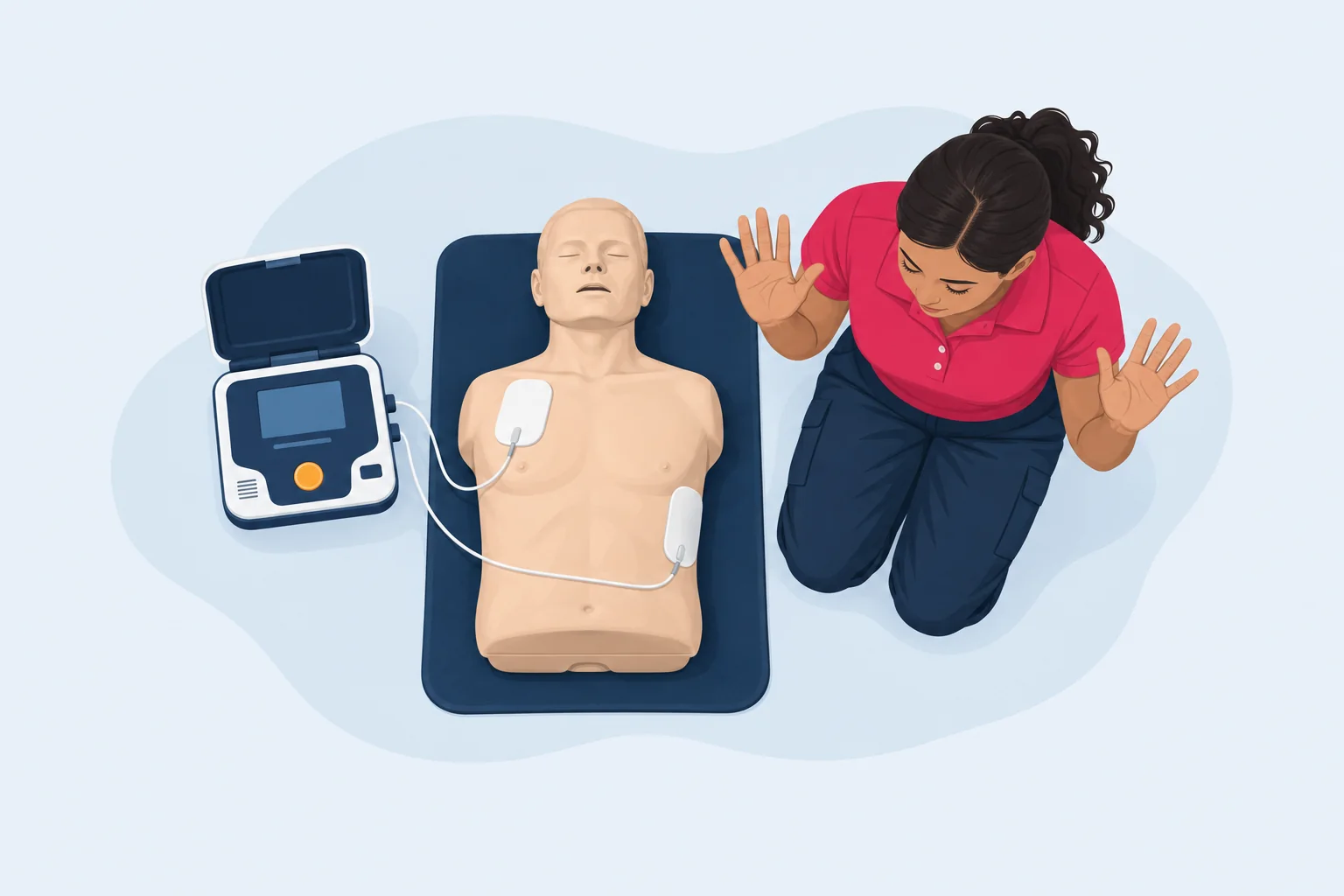
To use an AED, switch it on and follow its voice prompts. Bare the person's chest and stick the pads where the pictures show: one below the right collarbone, the other on the left side below the armpit. Keep everyone clear while it analyses the heart rhythm, press the shock button only if it tells you to, then restart CPR straight away.
What does an AED do?
An automated external defibrillator (AED) reads the heart's electrical rhythm through two sticky pads and decides whether a shock could help. Use it only on someone who is unresponsive and not breathing normally.
It looks for a shockable rhythm, such as ventricular fibrillation (VF), where the heart quivers instead of pumping. It won't shock a normal heartbeat, or a flat line with no electrical activity at all.
The Australian and New Zealand Committee on Resuscitation (ANZCOR) says CPR alone won't save someone in VF, and that survival drops by about 10% for every minute defibrillation is delayed. That's why the final D in the DRSABCD action plan is to attach an AED as soon as one arrives.
How do you use an AED?
Switch it on and do what it tells you. AEDs give spoken instructions for every step, and most also have pictures or a screen showing what to do.
Keep CPR going until the AED is on and the pads are attached. With two of you, one keeps pushing while the other sets up the AED. If nobody has called Triple Zero (000), call now on speaker. The call-taker can talk you through CPR and the AED.
How do you prepare the chest for AED pads?
Expose the whole chest and make sure the skin is dry, so the pads can stick firmly.
- Cut or pull clothing off the chest, including a bra.
- Wipe the chest dry if it's wet or sweaty.
- Shave a small patch only if thick chest hair would stop a pad sticking.
Use the scissors and razor in the AED's prep kit if it has one, but don't let this delay the shock.
Where do AED pads go on an adult?
One pad goes just below the right collarbone and the other on the left side of the chest, below the armpit. This is ANZCOR's standard adult position, and it puts the heart between the pads so the shock passes through it.
Match each pad to the diagram on it, peel off the backing and press it down firmly. If the person has large breasts, place the left pad to the side of the breast rather than on breast tissue.
Why does an AED say 'stand clear'?
Because it's analysing the heart rhythm, and touching the person can interfere with the reading. Stop CPR when it tells you to, say 'stand clear' out loud and hold your hands up so others keep off too.
'Shock advised' means it has found a shockable rhythm. 'No shock advised' means a shock won't help right now, not that the person has recovered, so go straight back to CPR. The AED will recheck the rhythm in about two minutes.
Do you have to press the shock button?
Only if it's a semi-automatic model, and even then the AED decides whether a shock is needed. When it advises one, check that nobody is touching the person, including you, then press the flashing shock button. A fully automatic AED has nothing to press: it tells everyone to stand clear, counts down and delivers the shock itself.
What do you do after an AED shock?
Restart chest compressions straight away. Don't pause to see whether the shock worked. ANZCOR's CPR guideline says not to interrupt compressions to check for a response or breathing. Carry on with 30 compressions to 2 breaths, or compressions only if you can't give breaths.
Leave the pads on and the AED switched on. It will stop you about every two minutes to recheck the rhythm, and it may advise more shocks.
Keep going until the person responds or breathes normally, a paramedic or other health professional takes over, or you're too exhausted to continue. If they start breathing normally, leave the pads on in case they need another shock.
Can you use an AED on someone who's wet or has a pacemaker?
Yes, with a few precautions.
- Get the person out of the water and dry their chest before attaching the pads. ANZCOR says there are no reports of rescuers being harmed by defibrillation in wet environments, but nobody should touch the person during a shock.
- Pacemakers and implanted defibrillators sit under the skin of the upper chest, most often on the left. If you can see or feel one, keep the pad at least 8 cm away from it.
- Never put a pad on top of a medication patch, such as a nicotine or pain-relief patch. It can block the shock and cause small burns. Peel the patch off and wipe the skin first.
Can you use an AED on a child?
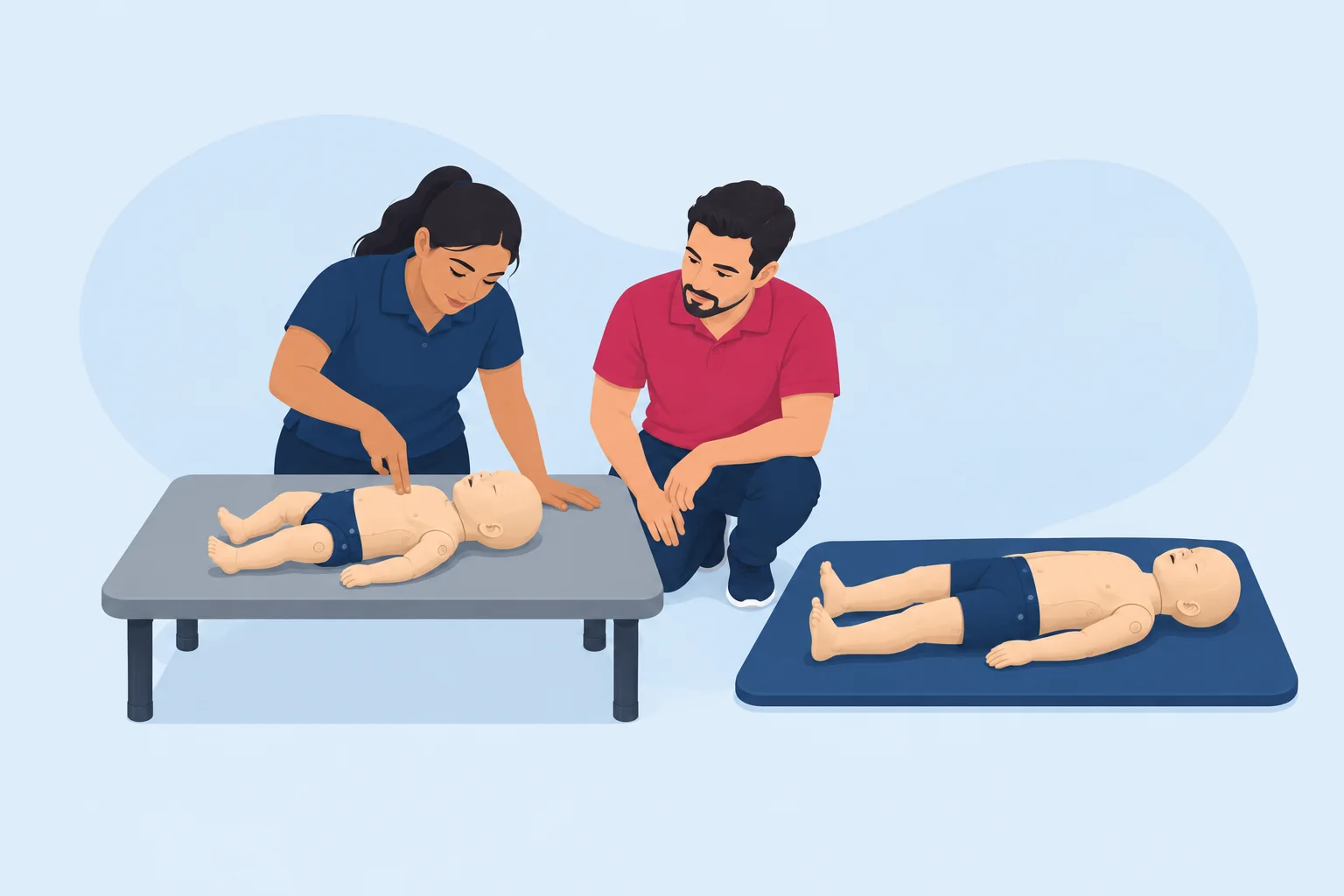
Yes. Adult pads are fine for children over 8. For younger children and babies, use paediatric pads and the AED's child setting where possible, and adult pads if it has neither. If the pads would touch on a small chest, put one on the front and the other on the upper back, between the shoulder blades. Our post on infant and child CPR covers what else changes.
Where can you find a public AED in Victoria?
Search Ambulance Victoria's AED registry, which you can view as a map from its Find an AED page. Owners add their AEDs to it through GoodSAM, the app that alerts registered responders to nearby cardiac arrests.
Registered AEDs are shared with Triple Zero call-takers, and GoodSAM responders alerted to a cardiac arrest get the location of the nearest one. AEDs are only shared while they're accessible, so one inside a locked building won't be.
Look up the AEDs nearest your home and workplace before you need one. In buildings, check the foyer or reception, and look for a green sign with a white heart and lightning bolt. If your workplace owns one, register it and check it monthly, as Ambulance Victoria recommends.
Where can you practise using an AED?
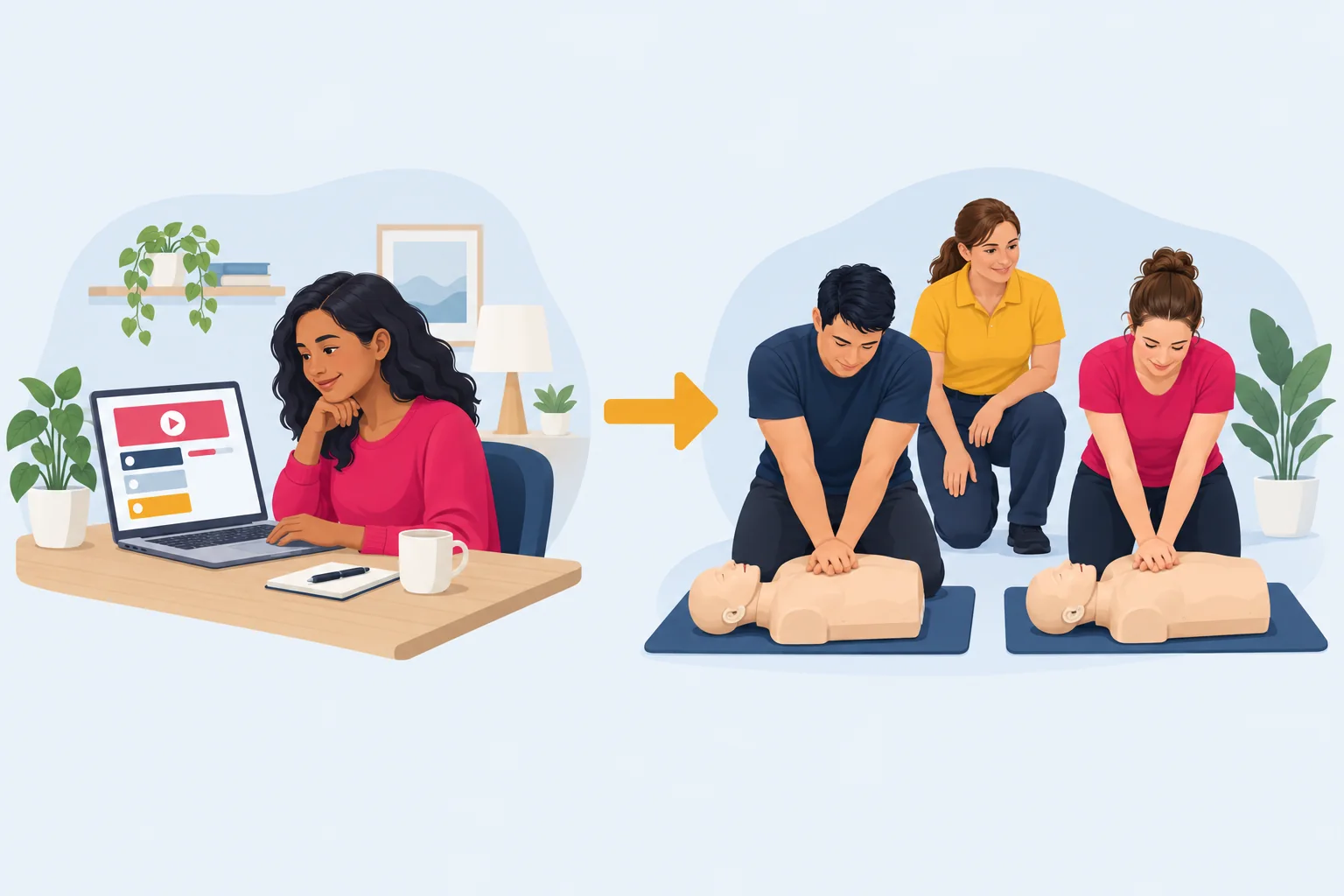
On a CPR course, with a training AED. You don't need training to use a real one, but ANZCOR notes that even brief training makes people faster and more accurate with the pads. Our HLTAID009 Provide CPR course includes hands-on AED practice, and you're assessed on a training defibrillator and a simulated cardiac arrest. For a team, ask about on-site training at your workplace in metropolitan Melbourne.
Sources
- Guideline 7 – Automated External Defibrillation in Basic Life Support – ANZCOR
- Guideline 8 – Cardiopulmonary Resuscitation (CPR) – ANZCOR
- Basic Life Support flowchart – ANZCOR
- Defibrillators and AEDs – Healthdirect
- How to use an AED – Victor Chang Cardiac Research Institute
- Register my AED – Ambulance Victoria

.svg)


